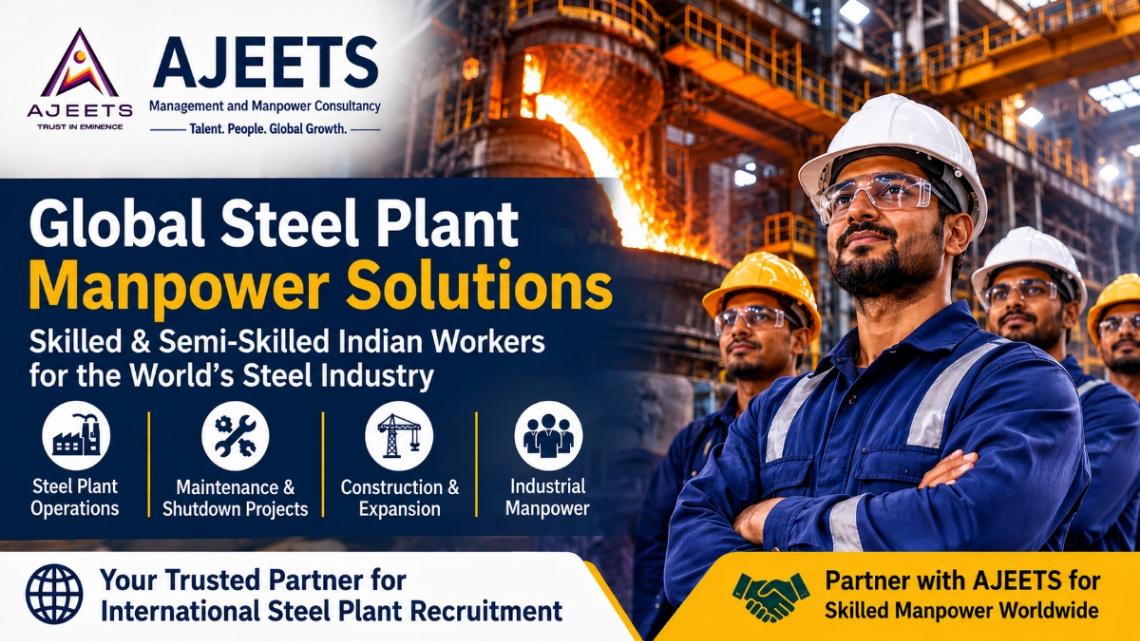
The steel industry is one of the most important pillars of modern industrial development. From residential buildings, commercial infrastructure and transportation networks to automobiles, machinery, energy facilities and large-scale industrial projects, steel plays an essential role in supporting economic growth worldwide.
Behind every steel product is a complex manufacturing process involving raw material handling, ironmaking, steelmaking, casting, rolling, fabrication, quality inspection and industrial maintenance. These operations require a combination of advanced machinery, specialised technical knowledge and experienced industrial workers.
As steel manufacturers continue to operate, upgrade existing facilities, develop new production units and introduce modern manufacturing technologies, the need for qualified manpower remains an important consideration.
Steel plants require experienced furnace operators, steel melters, rolling mill operators, mechanical fitters, industrial electricians, welders, instrumentation technicians, crane operators, QA/QC inspectors and maintenance professionals.
Consequently, steel plant manpower recruitment has become an important requirement for steel manufacturers, EPC contractors, industrial construction companies and maintenance service providers operating across international markets.
For international employers, sourcing skilled and semi-skilled workers with relevant industrial experience is essential to maintaining production efficiency, workplace safety and project timelines. At the same time, the global steel industry provides career opportunities for Indian workers who possess the technical capabilities and practical experience required for overseas employment.
1. Overview of the Global Steel Manufacturing Market
Steel manufacturing is a major global industry supported by construction, infrastructure development, automotive production, shipbuilding, renewable energy, engineering and heavy industrial manufacturing.
According to the World Steel Association's 2026 industry data, global crude steel production reached approximately 1.85 billion tonnes in 2025. China remained the largest producer, followed by India, the United States, Japan and Russia. India produced approximately 165 million tonnes, reinforcing its position as the world's second-largest steel-producing country.
worldsteel.org+1
The global steel manufacturing industry operates through different production technologies, including:
- Blast Furnace–Basic Oxygen Furnace (BF-BOF): A traditional integrated steelmaking route using iron ore and coke to produce molten iron, which is subsequently converted into steel.
- Electric Arc Furnace (EAF): A steelmaking process that primarily uses electrical energy to melt steel scrap or other metallic inputs.
- Induction Furnace: A melting technology widely used in foundries and certain steelmaking operations.
- Direct Reduced Iron (DRI): A process that produces metallic iron from iron ore without conventional blast furnace smelting, often used alongside electric arc furnaces.
The industry is also undergoing technological changes involving energy efficiency, automation, digital monitoring, scrap recycling and lower-emission steel production. These developments influence the types of technical skills employers require.
IEA+2
For recruitment companies, understanding these production technologies is important because manpower requirements differ according to the plant's production route, equipment configuration, capacity and operational requirements.
2. Countries and Regions with Significant Steel Manufacturing Activities
Steel production and industrial development are distributed across several continents. Each region has its own manufacturing environment, investment priorities, technical requirements and workforce requirements.
Some of the important steel-producing markets and industrial regions include:
Asia-Pacific
- China: Large integrated steel manufacturing facilities and extensive industrial production.
- India: Integrated steel plants, secondary steel manufacturers, rolling mills and expanding industrial infrastructure.
- Japan and South Korea: Advanced steel manufacturing, specialised production and technologically sophisticated facilities.
- Vietnam and Indonesia: Developing steel manufacturing capabilities and industrial production facilities.
- Malaysia, Thailand and Bangladesh: Steel production, processing and infrastructure-related industrial activities.
Middle East
- Saudi Arabia: Steel manufacturing, industrial development and infrastructure-related investments.
- United Arab Emirates: Steel production, metal processing, fabrication and industrial construction.
- Oman: Steel manufacturing and industrial development.
- Qatar: Steel production and infrastructure-related industrial activities.
- Iran: Established steel manufacturing and processing facilities.
Europe
- Germany: Advanced steel manufacturing and industrial engineering.
- Türkiye: Major steel production and export-oriented manufacturing.
- Italy and Spain: Steel processing, rolling mills and specialised manufacturing.
- Poland, France, Austria and Belgium: Established steel manufacturing and industrial engineering activities.
- Sweden and Finland: Steel production and developing lower-emission manufacturing technologies.
Americas
- United States and Canada: Integrated steel manufacturing, electric arc furnace production and industrial modernisation.
- Brazil and Mexico: Steel manufacturing, industrial infrastructure and metal processing.
- Argentina: Established steel production and industrial engineering activities.
Africa and Other Emerging Markets
- South Africa: Established steel manufacturing and industrial processing.
- Egypt and Algeria: Steel production and industrial development.
- Morocco: Steel processing and manufacturing.
- Kazakhstan: Steel production and heavy industrial operations.
These countries feature among the significant steel-producing economies identified in World Steel Association statistics.
worldsteel.org+1
It is important to understand that steel production figures do not automatically indicate current overseas recruitment vacancies. Actual manpower requirements depend on individual company investments, expansion schedules, maintenance contracts, project awards and local workforce availability.
For international recruitment agencies, these markets provide a broad geographical framework for identifying potential employer requirements and industrial manpower opportunities.
3. Why Steel Plants Require Skilled and Semi-Skilled Manpower
A steel plant is a complex industrial environment where different production departments and maintenance teams operate together.
Even highly automated manufacturing facilities depend on trained personnel to monitor equipment, control production processes, maintain machinery, perform inspections and respond to operational problems.
The demand for manpower generally arises from the following requirements:
Continuous production operations: Steel manufacturing facilities often operate around the clock. Furnace operators, casting operators, production technicians and shift supervisors are needed to maintain production activities.
Equipment maintenance: Heavy machinery, hydraulic systems, motors, conveyors, cranes, pumps and industrial electrical installations require regular inspection and maintenance.
Plant expansion and modernisation: New production lines, furnace installations, rolling mills and industrial facilities require construction, fabrication, installation and commissioning personnel.
Quality control: Steel products must meet the technical specifications and quality requirements established by manufacturers and customers.
Shutdown and turnaround activities: Planned maintenance shutdowns require additional manpower to complete inspections, repairs, replacement work and equipment servicing within scheduled periods.
The combination of these requirements makes skilled manpower an essential component of steel plant operations.
4. Major Job Positions Required in Steel Plants
Steel manufacturing requires workers across production, mechanical, electrical, instrumentation, fabrication, quality control and safety departments.
The following are some of the major positions recruited for steel plants and associated industrial projects.
A. Steelmaking and Production Department
1. Steel Melters and Furnace Operators
Responsible for operating steelmaking furnaces, monitoring melting conditions, controlling temperatures and following production instructions.
2. Electric Arc Furnace (EAF) Operators
Operate electric arc furnace systems, monitor electrical and melting parameters, supervise charging activities and coordinate with production teams.
3. Induction Furnace Operators
Handle induction melting equipment, monitor furnace temperatures and maintain appropriate melting and pouring procedures.
4. Steel Casting Operators
Assist with molten steel handling, casting operations, mould preparation and production monitoring.
5. Continuous Casting Machine (CCM) Operators
Operate continuous casting equipment used to convert molten steel into billets, blooms or slabs.
6. Rolling Mill Operators
Operate rolling mill machinery used to produce steel bars, rods, structural sections, plates and other finished products.
B. Mechanical and Maintenance Department
7. Mechanical Fitters
Install, inspect, dismantle and repair industrial machinery, mechanical assemblies and production equipment.
8. Millwrights
Handle machinery installation, alignment, assembly, levelling and maintenance of heavy industrial equipment.
9. Hydraulic Technicians
Maintain hydraulic power units, cylinders, pumps, valves and hydraulic systems used in steel manufacturing machinery.
10. Industrial Maintenance Technicians
Perform preventive, corrective and breakdown maintenance on industrial machinery and equipment.
11. Refractory Workers
Install, repair and maintain refractory linings in furnaces, ladles, kilns and other high-temperature industrial equipment.
C. Electrical and Instrumentation Department
12. Industrial Electricians
Install, inspect and repair electrical systems, motors, cables, switchgear and industrial control panels.
13. Instrumentation Technicians
Maintain and calibrate industrial instruments, sensors, transmitters and measurement systems.
D. Fabrication and Industrial Construction
14. Welding Professionals
Perform industrial welding using processes such as SMAW, GTAW, GMAW and FCAW, depending on project requirements.
15. Fabricators
Read engineering drawings, measure, cut, assemble and fabricate steel structures and industrial components.
16. CNC Operators
Operate CNC cutting, machining and fabrication equipment according to engineering specifications.
17. Crane Operators
Operate overhead cranes and other approved lifting equipment used for moving heavy materials and machinery.
18. Rigging and Scaffolding Workers
Support heavy lifting, load positioning, equipment installation and safe access arrangements during construction and maintenance work.
E. Quality Control, Safety and Supervision
19. QA/QC Inspectors
Inspect materials, welding activities, dimensions and finished products to verify compliance with project specifications and quality standards.
20. Safety Officers
Monitor workplace safety, conduct inspections, support risk assessments and ensure compliance with applicable health and safety procedures.
21. Production Supervisors and Engineers
Supervise production teams, monitor operational performance, coordinate maintenance and ensure manufacturing targets are achieved.
These positions may be required on permanent, contractual, project-based or shutdown employment arrangements.
5. Essential Technical Skills, Qualifications and Experience
Steel plant employers generally look for candidates with relevant industrial experience, technical knowledge and practical capabilities.
The required qualifications depend on the position, equipment and production technology involved.
Common requirements include:
- ITI, diploma or engineering qualifications in mechanical, electrical, instrumentation, welding or related technical disciplines.
- Practical experience in steel plants, rolling mills, foundries, heavy fabrication workshops or industrial manufacturing facilities.
- Knowledge of industrial machinery, production processes and equipment maintenance.
- Ability to understand technical drawings, equipment manuals and operating instructions.
- Experience with preventive maintenance, breakdown maintenance and troubleshooting.
- Familiarity with industrial safety procedures and personal protective equipment.
- Experience working in shift-based production environments.
- Knowledge of quality inspection procedures and relevant technical standards.
For specialised positions, employers may require additional certifications.
For example, welding professionals may need approved welding qualifications and practical trade tests. Crane operators may require valid equipment-specific licences. Electricians and instrumentation technicians may need relevant technical certifications and experience with industrial systems.
Safety knowledge is particularly important in steel manufacturing because workers may encounter molten metal, high temperatures, heavy lifting equipment, moving machinery, electrical hazards and confined spaces. The International Labour Organization provides industry-specific safety guidance covering these risks and the importance of training and prevention.
International Labour Organization+1
Employers should assess technical competence through practical evaluations, trade tests, employment history verification and interviews rather than relying exclusively on educational certificates.
6. Manpower Requirements During Different Steel Plant Project Stages
The workforce required by a steel plant changes according to its project stage.
Understanding these requirements helps employers plan recruitment activities and select suitable manpower categories.
A. Steel Plant Construction
New steel plant construction and expansion projects require substantial industrial construction manpower.
Common requirements include:
- Structural fabricators and welders.
- Mechanical fitters and pipe fitters.
- Industrial electricians.
- Riggers and scaffolders.
- Crane operators.
- Steel structure erectors.
- Equipment installation technicians.
- Helpers and general industrial workers.
B. Equipment Installation and Commissioning
During equipment installation and commissioning, employers require specialised technicians and engineers to assemble machinery, connect electrical systems, test instruments and verify equipment performance.
Mechanical supervisors, electrical technicians, instrumentation specialists, millwrights and commissioning engineers play important roles during this stage.
C. Steel Plant Operations
Once the plant becomes operational, regular manpower is required across furnace operations, casting, rolling, quality inspection, material handling and maintenance departments.
Production operators, shift supervisors, technicians and industrial maintenance workers are essential to daily operations.
D. Plant Maintenance
Preventive and corrective maintenance activities require mechanical fitters, electricians, hydraulic technicians, millwrights, welders and instrumentation technicians.
E. Shutdown and Turnaround Projects
Planned steel plant shutdowns involve concentrated maintenance activities within a specific time frame.
Employers may require additional steel plant shutdown manpower, including:
- Mechanical maintenance teams.
- Refractory technicians and workers.
- Industrial welders and fabricators.
- Electrical and instrumentation technicians.
- Crane operators and riggers.
- Scaffolding workers.
- QA/QC inspectors.
- Safety officers and supervisors.
Shutdown recruitment requires careful planning because manpower must be available within the project's mobilisation schedule and possess the specific technical experience needed for the work.
7. Global Opportunities for Indian Steel Plant Workers
India has an established steel manufacturing ecosystem, supported by integrated steel plants, secondary steel producers, rolling mills, foundries, fabrication workshops and industrial engineering companies.
This provides a pool of workers with practical experience in different steel manufacturing and industrial maintenance activities.
Indian professionals may find overseas employment opportunities in positions such as:
- Steel furnace operators and melting technicians.
- Rolling mill operators.
- Mechanical and electrical maintenance technicians.
- Industrial electricians and instrumentation technicians.
- Industrial welders and fabricators.
- Refractory workers.
- CNC operators.
- Hydraulic technicians.
- Crane operators and riggers.
- QA/QC inspectors.
- Production supervisors and maintenance engineers.
Potential employment markets include the Middle East, Europe, Asia, Africa and other regions where employers have verified industrial manpower requirements.
However, overseas employment opportunities vary according to employer demand, local labour regulations, project requirements, work permits, qualification recognition and candidate experience.
Candidates interested in overseas steel plant jobs should maintain updated CVs, relevant technical certificates, experience letters, passport documentation and trade-test records.
They should also verify employment contracts, salary details, working conditions, visa arrangements and recruitment procedures before accepting an overseas position.
For Indian workers, choosing a legitimate recruitment channel and understanding the destination country's employment requirements are essential steps towards a safe and professional international career.
8. Challenges Faced by International Employers in Recruiting Qualified Industrial Manpower
Recruiting industrial workers for steel manufacturing facilities can be challenging, particularly when employers need large teams or specialised technical personnel within strict project deadlines.
Some common recruitment challenges include:
Limited availability of specialised skills: Finding experienced EAF operators, CCM operators, refractory technicians and specialised maintenance professionals can require targeted sourcing.
Verification of industrial experience: Employers need to establish whether candidates have actually worked with the machinery, production processes and equipment relevant to the vacancy.
Large-volume recruitment: Construction and shutdown projects may require multiple categories of workers within a short mobilisation period.
Technical assessment: CV screening alone cannot establish practical competence. Employers may require trade tests, technical interviews and skill demonstrations.
Documentation and mobilisation: International recruitment involves passport verification, employment documentation, medical examinations, work permits and visa procedures, depending on the destination country.
Safety and compliance: Workers must understand site-specific safety requirements and possess the necessary training for their assigned responsibilities.
A structured international recruitment process can help employers address these challenges and reduce unnecessary delays.
9. How International Recruitment Agencies Can Support Steel Plant Employers
International manpower recruitment agencies play an important role in connecting overseas employers with qualified candidates from labour markets such as India.
For steel plant owners, EPC contractors, industrial project developers and maintenance companies, an experienced recruitment consultancy can provide support throughout the candidate sourcing and selection process.
The recruitment process generally involves:
- Understanding the employer's manpower requirements and technical specifications.
- Identifying the required number of workers and job categories.
- Sourcing suitable candidates through relevant recruitment networks.
- Screening CVs, qualifications and industrial experience.
- Conducting preliminary interviews and coordinating trade tests.
- Shortlisting candidates for employer interviews and final selection.
- Supporting documentation and deployment coordination in accordance with applicable regulations.
AJEETS Management and Manpower Consultancy is an India-based international recruitment and manpower consultancy focused on supplying skilled, semi-skilled and unskilled Indian manpower to overseas employers.
For steel manufacturing and associated industrial projects, AJEETS can work with international employers to understand their workforce requirements and identify suitable Indian candidates across relevant technical and industrial job categories.
Whether the requirement involves furnace operators, rolling mill technicians, mechanical fitters, industrial electricians, welders, fabricators or maintenance workers, recruitment should be based on the employer's actual job specifications and candidate competence.
The objective is to establish a transparent recruitment process that connects employers with appropriately assessed manpower while helping candidates understand the nature of the overseas employment opportunity.
10. Why Partner with a Reliable Indian Manpower Recruitment Consultancy?
Selecting the right recruitment partner is an important decision for international steel manufacturers and industrial contractors.
A reliable Indian manpower recruitment consultancy should understand technical job requirements, candidate sourcing, industrial experience verification and international deployment procedures.
Employers should evaluate recruitment partners based on the following factors:
- Experience in international manpower recruitment.
- Ability to source skilled and semi-skilled industrial candidates.
- Understanding of technical job descriptions and trade requirements.
- Transparent recruitment and commercial communication.
- Proper candidate screening and documentation practices.
- Compliance with applicable Indian and destination-country recruitment regulations.
- Ability to coordinate employer interviews and technical assessments.
- Clear communication regarding recruitment timelines and mobilisation requirements.
For large industrial projects, employers should also discuss workforce planning, recruitment schedules, replacement terms, trade-test arrangements and deployment responsibilities before finalising a recruitment agreement.
A suitable recruitment partner should function as a workforce sourcing and coordination partner, not simply as a provider of candidate CVs.
11. Conclusion: Building a Skilled Workforce for the Global Steel Industry
The global steel manufacturing industry depends on experienced industrial professionals to maintain production, improve operational efficiency, support plant expansion and complete critical maintenance activities.
From furnace operators and steel casting technicians to industrial electricians, mechanical fitters, welders, fabricators, crane operators and QA/QC inspectors, every workforce category contributes to the successful functioning of steel manufacturing facilities.
As steel producers continue to invest in modernisation, industrial infrastructure and evolving manufacturing technologies, workforce planning and access to technically competent manpower will remain important business priorities.
For international steel manufacturers, EPC contractors, plant operators and shutdown service providers looking for Indian industrial manpower, partnering with a dependable recruitment consultancy can help simplify candidate sourcing and selection.
AJEETS Management and Manpower Consultancy welcomes enquiries from international steel plant employers, industrial contractors and project developers seeking skilled and semi-skilled Indian manpower.
Whether you require a small technical team or a larger workforce for construction, production, maintenance or shutdown activities, our team can discuss your requirements and support your recruitment planning.
Connect with AJEETS to discuss your international steel plant manpower requirements and explore suitable Indian workforce sourcing solutions.