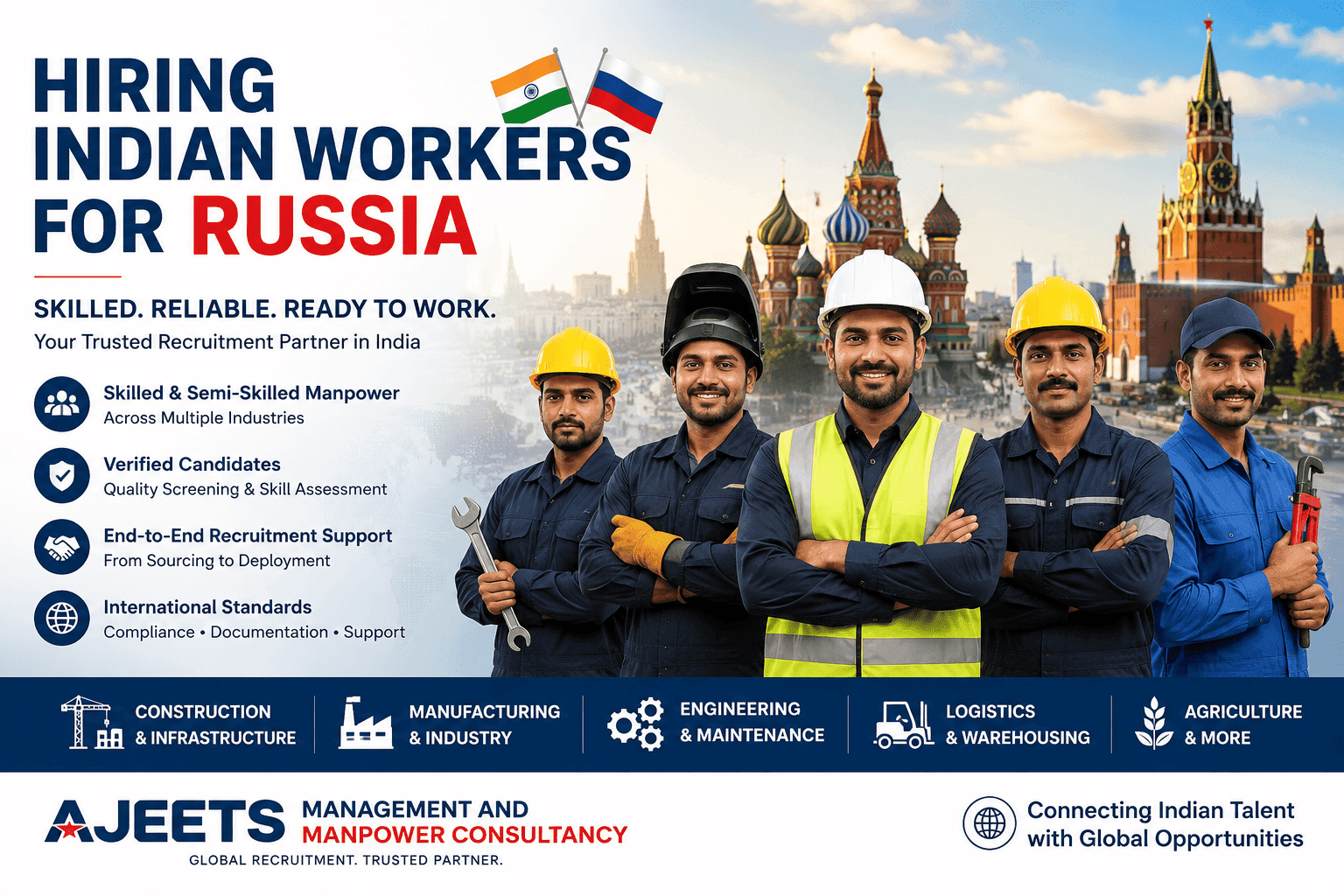
Russia's evolving labour market is creating new opportunities for international recruitment. As employers in construction, manufacturing, industrial production, agriculture, logistics and other sectors face workforce requirements, international manpower can become an important part of their recruitment strategy.
For Russian companies, finding qualified workers with the right technical skills, experience and reliability can be challenging for certain positions. At the same time, India offers a large and diverse workforce across skilled, semi-skilled and technical occupations.
This has increased interest in structured recruitment from India to Russia.
For employers, however, recruiting workers internationally is more than simply finding candidates. It requires proper workforce planning, candidate screening, documentation, employment contracts and compliance with Russian immigration and labour requirements.
For Indian workers, it is equally important to understand that overseas employment should always be based on a genuine job offer, a clear employment contract and the appropriate legal authorization to work.
In this guide, we explain how Russian employers can approach manpower recruitment from India, which occupations may be relevant, how the recruitment process works, and what both employers and candidates should consider before proceeding.
Why Are Russian Companies Looking at International Recruitment?
Russia has been experiencing significant labour-market pressure in recent years. Low unemployment and demographic changes have contributed to difficulties in filling certain positions, while demand for workers remains important across several sectors.
Recent analysis has identified shortages particularly affecting manufacturing, construction and services, while international recruitment from countries such as India has received increasing attention.
The Russian government's 2026 framework for foreign workers entering on visas also provides an important indication of the scale and diversity of international workforce demand. The approved requirement covers 278,940 foreign workers, with priority professional groups including construction, manufacturing, machinery and metalworking, industrial equipment operation, agriculture and electrical/electronics.
This does not mean every Russian company can automatically hire foreign workers or that every occupation is available to foreign nationals. Instead, it demonstrates why employers and recruitment agencies need to approach international manpower recruitment through a structured and compliant process.
Which Industries in Russia May Hire Foreign Workers?
The exact demand varies by region, employer and occupation, but several industries can be relevant to international manpower recruitment.
1. Construction and Infrastructure
Construction is one of the most important areas for skilled and semi-skilled manpower.
Potential requirements can include:
- Masons
- Formwork carpenters
- Steel fixers
- Welders
- Plasterers
- Tile workers
- General construction workers
- Fabricators
- Equipment operators
- Skilled construction technicians
Russia's 2026 foreign-worker planning specifically includes workers engaged in construction and related occupations among the priority professional groups.
For large projects, the ability to source multiple qualified workers and conduct trade-based screening can be particularly valuable.
2. Manufacturing and Industrial Production
Manufacturing is another important area for international recruitment.
Potential roles may include:
- Production workers
- Machine operators
- Fabricators
- Welders
- Mechanical technicians
- Maintenance workers
- Production-line personnel
- Industrial specialists
The 2026 Russian foreign-worker allocation includes substantial categories covering manufacturing, metalworking, machinery, mechanics and repair occupations.
3. Mechanical and Technical Trades
Russian companies requiring technically trained workers may consider international recruitment for positions such as:
- Mechanical technicians
- Maintenance technicians
- Mechanics
- Industrial repair workers
- Equipment operators
- Fabricators
- Welders
- Electrical technicians
The suitability of a particular occupation depends on the employer's requirement and applicable Russian regulations.
4. Agriculture and Food-Related Production
Agriculture is also represented within Russia's 2026 priority professional categories for foreign workers.
Potential requirements may include:
- Agricultural workers
- Farm workers
- Production workers
- Equipment operators
- Skilled agricultural personnel
Employers should determine the exact occupation classification and applicable authorization before recruitment begins.
5. Logistics, Warehousing and Support Operations
Growing industrial and commercial operations can also create requirements for:
- Warehouse workers
- Material handlers
- Equipment operators
- Logistics support personnel
- Maintenance workers
However, employers should not assume that every position is automatically available to foreign workers. The occupation, region and immigration status of the worker must be checked before recruitment.
What Types of Indian Workers Can Russian Employers Recruit?
India's workforce covers a broad range of technical and trade skills. Depending on the employer's requirements and applicable Russian authorization, recruitment can potentially focus on several categories.
Skilled Workers
Examples include:
- Welders
- Electricians
- Plumbers
- Carpenters
- Mechanics
- Technicians
- Fabricators
- Machine operators
- Maintenance specialists
Construction Workers
Potential construction manpower categories include:
- Masons
- Steel fixers
- Formwork carpenters
- Tile workers
- Plasterers
- General construction workers
- Fabricators
- Skilled helpers
Industrial Workers
Industrial recruitment may include:
- Production workers
- Machine operators
- Mechanical workers
- Maintenance workers
- Fabricators
- Industrial technicians
- Equipment operators
Agricultural Workers
Depending on the employer and applicable authorization, recruitment may also involve:
- Agricultural workers
- Farm workers
- Agricultural equipment operators
- Production-support workers
The final candidate profile should always be based on an actual employer requirement rather than simply recruiting workers first and looking for jobs afterward.
Why Consider Indian Workers for Russian Projects?
India has a large and diverse labour pool covering construction, manufacturing, engineering, technical trades, hospitality, logistics and other industries.
For international employers, one of the main advantages of working with an established recruitment agency is the ability to identify candidates according to the exact job specification.
For example, an employer requiring 50 welders should ideally receive candidates who have been assessed according to the required welding process, experience level, certification requirements and project environment—not simply candidates whose CVs contain the word "welder."
A structured Indian recruitment process can include:
- Candidate sourcing
- CV screening
- Experience verification
- Trade testing
- Technical interviews
- Employer interviews
- Document verification
- Pre-departure preparation
- Recruitment coordination
The objective should be quality matching rather than simply maximizing the number of candidates.
Russia's 2026 Foreign-Worker Framework: What Employers Should Know
This is one of the most important areas for Russian employers considering recruitment from India.
The Russian government approved a 2026 requirement for 278,940 foreign workers entering Russia on visas, together with 278,940 work invitations and 278,940 work permits under the relevant quota framework.
The priority professional groups include, among others:
Professional category2026 planned requirementWorkers in food, woodworking, textile and related industries71,088Construction and related occupations, excluding electricians55,312Metalworking, machinery, mechanics and repair45,391Industrial plant and stationary equipment operators19,747Unskilled workers in mining, construction, manufacturing and transport13,287Science and technology technicians12,123Electrical and electronics workers6,829Agriculture workers5,091Science and technology specialists8,557Other professional groups37,095
These figures come from the Russian government's 2026 allocation and should not be interpreted as vacancies available to Indian workers or as a guarantee that a particular employer can recruit workers in a particular occupation. They indicate the categories included within the country's 2026 foreign-worker planning framework.
The practical lesson for employers is simple: check eligibility and authorization before beginning large-scale recruitment.
How Does International Recruitment from India to Russia Work?
A professional recruitment process normally begins with the employer—not with the candidate.
Step 1: Employer Sends the Manpower Requirement
The Russian employer provides details such as:
- Number of workers required
- Job titles
- Required skills
- Experience
- Work location
- Salary
- Working hours
- Overtime
- Accommodation
- Food or allowance
- Transportation
- Contract duration
- Expected joining date
Step 2: Recruitment Requirements Are Reviewed
The recruitment agency reviews the requirement and identifies the candidate profile.
At this stage, the employer and recruitment partner should also clarify the applicable work authorization and immigration requirements.
Step 3: Candidates Are Sourced in India
Candidates can be sourced through recruitment databases, regional networks, advertisements, trade networks and other legitimate recruitment channels.
Step 4: CV Screening
Candidates are screened according to:
- Experience
- Skills
- Qualifications
- Previous international experience
- Relevant certifications
- Job suitability
Step 5: Trade Testing and Technical Assessment
For technical positions, practical assessment can be especially important.
For example, a welding requirement may require testing according to the employer's specified welding process and technical standards.
Step 6: Employer Interviews
Shortlisted candidates can then be presented to the Russian employer for:
- Online interviews
- Technical interviews
- Trade tests
- Final selection
Step 7: Document Verification
Selected candidates should provide the documents required for the employment and immigration process.
Step 8: Employment Contract
The candidate should receive clear information about:
- Salary
- Working hours
- Duties
- Contract period
- Benefits
- Accommodation
- Leave
- Overtime
- Other employment conditions
Step 9: Work Authorization and Visa Process
Where required, the appropriate work authorization, invitation and visa procedures must be completed.
The exact process depends on the worker's circumstances, employer, occupation and applicable Russian rules.
Step 10: Pre-Departure Preparation
Before departure, candidates should receive appropriate information about:
- Employment conditions
- Travel
- Accommodation
- Workplace expectations
- Documentation
- Local conditions
- Emergency contacts
- Worker rights and responsibilities
Step 11: Travel and Deployment
Once the required procedures are completed, the selected workers can travel and begin the deployment process according to the employer's arrangements.
Step 12: Post-Arrival Coordination
A professional recruitment partner can continue communication between the employer and workers during onboarding and deployment.
What Documents May Be Required?
The exact documentation depends on the recruitment and immigration process.
Common documents may include:
- Valid passport
- Passport photographs
- Educational certificates
- Trade certificates
- Experience certificates
- Employment-related documents
- Medical documentation where required
- Background or police documentation where legally required
- Signed employment documents
- Other documents requested by the employer or authorities
Candidates should never assume that a document list from an old recruitment campaign automatically applies to a new Russian job.
What Should Russian Employers Consider Before Hiring Workers from India?
Before launching recruitment, employers should clearly define the complete employment package.
Salary
Specify the salary clearly and identify whether the amount is:
- Gross or net
- Monthly or daily
- Before or after deductions
Working Hours
Clearly specify:
- Daily working hours
- Weekly working days
- Overtime arrangements
- Rest days
- Shift patterns
Accommodation
If accommodation is provided, clarify:
- Whether it is free
- Number of workers per room
- Utilities
- Distance from workplace
- Facilities available
Food
If food is provided, specify whether meals are:
- Free
- Subsidized
- Provided through an allowance
Transportation
Employers should explain how workers will travel between accommodation and the workplace.
Medical and Insurance Arrangements
The employer should clearly communicate applicable medical coverage and insurance arrangements.
Contract Duration
Candidates should know whether the employment is:
- Fixed-term
- Project-based
- Renewable
- Subject to other conditions
Work Authorization
This is particularly important for foreign workers.
Employers should establish the correct authorization route before candidates travel.
Russian law and administrative requirements can change, so employers should verify the applicable rules for the specific recruitment campaign.
How Can AJEETS Help Russian Employers Recruit Workers from India?
AJEETS Management and Manpower Consultancy provides international recruitment and workforce solutions for employers seeking skilled, semi-skilled and professional manpower.
AJEETS describes its recruitment process as including sourcing and screening, interviews and selection, assistance with visa and work-permit processes, and relocation support.
For a Russian employer, a structured recruitment partnership can help simplify several stages of international hiring.
Requirement Analysis
We first understand:
- Position
- Skills
- Quantity
- Experience
- Salary
- Benefits
- Location
- Contract
- Joining schedule
Candidate Sourcing
Candidates can be sourced according to the employer's specific requirements rather than through a generic database search.
Screening and Selection
Candidates can be screened based on:
- Experience
- Technical skills
- Qualifications
- Documentation
- Job suitability
Trade Testing
Where appropriate, technical candidates can undergo trade or skill assessment before being recommended to the employer.
Interview Coordination
AJEETS can coordinate communication between employers and shortlisted candidates.
Documentation Support
The recruitment process can include coordination of candidate documentation required by the employer and relevant authorities.
Pre-Departure Support
Candidates can be briefed about the employment, travel and deployment process before departure.
International Recruitment Experience
AJEETS states that it has operated in international recruitment since 2006 and provides recruitment services across multiple industries and international markets.
For Russian employers considering recruitment from India, the objective should be to create a recruitment process that is transparent, compliant and focused on the right candidate for the right position.
How Indian Workers Can Find Legitimate Jobs in Russia
International employment can provide valuable opportunities, but candidates should be careful when considering overseas job offers.
1. Verify the Employer
Ask for:
- Company name
- Workplace location
- Job description
- Employment contract
- Salary details
- Contact information
2. Understand the Contract
Do not accept an overseas job based only on a WhatsApp message or social-media advertisement.
Read the employment conditions carefully.
3. Confirm Salary and Benefits
Ask for written information about:
- Salary
- Overtime
- Accommodation
- Food
- Transportation
- Medical coverage
- Leave
- Contract period
4. Verify the Recruitment Agency
Candidates should deal with legitimate recruitment channels and verify the credentials of the organization handling their recruitment.
5. Be Careful With Unrealistic Promises
Candidates should be cautious about claims such as:
- "100% visa guarantee"
- "100% job guarantee"
- "No documents required"
- "Pay immediately and your visa is guaranteed"
- Extremely high salaries with no clear job description
6. Confirm Work Authorization
Do not travel to Russia for employment without understanding and completing the required legal employment and immigration process.
7. Keep Copies of Important Documents
Candidates should retain copies of:
- Passport
- Employment contract
- Visa/work authorization documents
- Recruitment documents
- Employer contact details
- Emergency contacts
India's Ministry of Labour and Employment has also emphasized safe and legal mobility for Indian workers going to destinations including Russia and highlighted initiatives such as insurance and pre-departure orientation and training.
Questions Russian Employers Should Ask a Recruitment Agency
Before choosing an international recruitment partner, employers should ask:
- How many workers can you source?
- Which occupations can you recruit?
- Where do you source candidates in India?
- How do you screen candidates?
- Do you conduct trade tests?
- Can candidates be interviewed directly by the employer?
- How are candidate documents verified?
- What is the expected recruitment timeline?
- Can you handle bulk manpower requirements?
- What pre-departure support do you provide?
- How do you coordinate with overseas employers?
- What information do you require from the employer before recruitment starts?
A good recruitment partner should be willing to explain its process clearly rather than simply promising a large number of workers.
Why Russia Could Become an Important Market for International Recruitment
Russia's labour-market situation is creating an increasingly relevant environment for international workforce recruitment.
The country's 2026 foreign-worker planning covers hundreds of thousands of workers across construction, manufacturing, industrial operations, agriculture, technical occupations and other professional groups.
For Russian employers, the opportunity is not simply about finding workers from another country. It is about building a reliable recruitment pipeline capable of delivering candidates with the required skills, experience and documentation.
For Indian workers, the opportunity should be approached with equal responsibility: legitimate employment, transparent contracts and proper work authorization must come before travel.
This is where a professional international recruitment partner can add value.
Looking to Hire Indian Workers for Russia?
If your Russian company is planning to recruit manpower from India, AJEETS can help you structure your requirement and identify suitable candidates according to your project and workforce needs.
Contact AJEETS for International Recruitment
When contacting a recruitment agency, Russian employers should provide:
- Number of workers required
- Job titles
- Required skills
- Minimum experience
- Work location
- Salary
- Working hours
- Overtime terms
- Accommodation
- Food/allowances
- Transportation
- Contract duration
- Expected joining timeline
Providing these details at the beginning allows the recruitment process to be more focused and transparent.
For Indian Job Seekers
Indian professionals and skilled workers interested in Russia should also ensure that any opportunity they consider is based on a genuine employment requirement and follows the applicable legal recruitment and work-authorization process.
Do not pay money based solely on a social-media promise or verbal guarantee. Always verify the job, employer, contract and recruitment process before making travel arrangements.
Final Thoughts
The Russia–India manpower recruitment market is becoming increasingly relevant as Russian employers explore new sources of international talent.
The opportunity is particularly relevant to industries such as construction, manufacturing, industrial production, machinery, maintenance, agriculture and other sectors included in Russia's foreign-worker planning.
But successful international recruitment requires more than connecting an employer with a candidate.
It requires careful workforce planning, accurate job descriptions, candidate screening, skill assessment, document verification, transparent employment conditions and compliance with the applicable immigration and labour requirements.
For employers, the right recruitment partner can make that process more organized and efficient.
For workers, the right approach can help them distinguish genuine employment opportunities from risky or misleading offers.
If your company is looking to hire Indian workers for Russia, AJEETS Management and Manpower Consultancy can assist with international manpower sourcing and recruitment coordination based on your specific workforce requirements.